

Iron Fertilizer: Recognizing Deficiency and Choosing the Right Chelated Form for Modern Agriculture
Iron (Fe) is required by plants in relatively small amounts compared to macronutrients like nitrogen, phosphorus, and potassium, yet its role is irreplaceable. Iron deficiency remains one of the most common and yield-limiting micronutrient problems in field crops, orchards, and greenhouse production, especially in calcareous and alkaline soils. This article explains why plants need iron, how to recognize deficiency in the field, and why the new generation of chelated iron fertilizers — particularly the ortho-ortho and ortho-para isomers of Fe-EDDHA — represent the most effective solution available today.
Why Plants Need Iron
Iron participates in dozens of essential biochemical processes:
- Chlorophyll synthesis: although iron is not part of the chlorophyll molecule itself, it is required for the enzymes that build it. Without adequate iron, chlorophyll production stalls.
- Electron transport: iron is a core component of cytochromes and ferredoxin, proteins central to photosynthesis and respiration.
- Enzyme activity: many enzymes involved in nitrogen fixation, DNA synthesis, and hormone metabolism depend on iron as a cofactor.
- Energy metabolism: iron-sulfur clusters are essential for ATP production within the plant cell.
Because iron is immobile within the plant — it cannot easily be relocated from older to younger tissue — deficiency symptoms always appear first on new growth.
Recognizing Iron Deficiency in Plants
Field diagnosis of iron deficiency is usually straightforward if growers know what to look for:
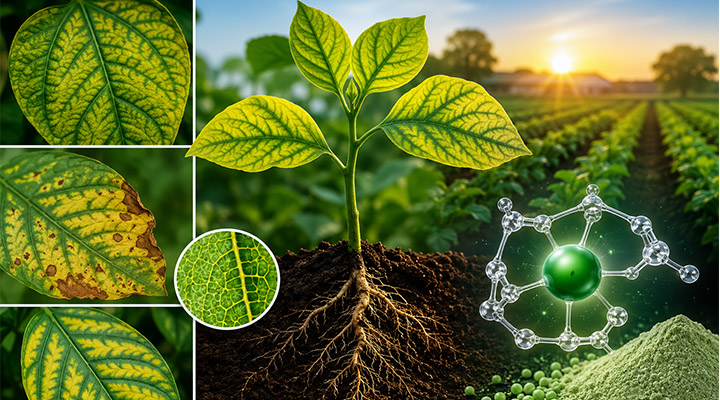
- Interveinal chlorosis on young leaves: the classic symptom. Leaf veins stay dark green while the tissue between them turns pale yellow to almost white. This pattern is most visible on the newest, uppermost leaves.
- Progression to necrosis: in severe or prolonged deficiency, chlorotic tissue can dry out and turn brown at the leaf margins.
- Stunted shoot growth: new shoots emerge weak, short, and thin.
- Reduced fruit set and quality: in orchard crops (citrus, stone fruit, grapevine) and in vegetables grown in high-pH soils, chronic iron deficiency reduces flowering, fruit size, and overall yield.
- Whole-canopy yellowing: in advanced cases, entire branches or the whole plant can appear pale, especially in calcareous or poorly drained soils.
It is important to distinguish iron chlorosis from nitrogen or sulfur deficiency: nitrogen deficiency shows up on older leaves first (since nitrogen is mobile), while sulfur deficiency causes more uniform yellowing across young leaves without the sharp vein contrast typical of iron deficiency.
Why Iron Deficiency Happens Even in Iron-Rich Soils
Paradoxically, most soils contain far more total iron than plants will ever need. The problem is rarely a lack of iron in the soil — it is the availability of that iron to plant roots. Iron deficiency is triggered by:
- High soil pH (calcareous/alkaline soils): above pH 7.5–8, iron rapidly converts to insoluble ferric hydroxide forms that roots cannot absorb.
- High soil bicarbonate content: common in soils irrigated with hard, calcareous water, bicarbonate interferes with iron uptake and internal transport within the plant (this is often called “lime-induced chlorosis”).
- Waterlogged or compacted soils: poor aeration reduces root respiration and iron uptake efficiency.
- Excess phosphorus: high phosphate levels can precipitate iron into unavailable compounds.
- Cold soil temperatures: root metabolic activity slows, reducing the plant’s ability to actively acquire iron even when it is technically present.
This is precisely why simple, unchelated iron salts often fail to correct deficiency in the field.
The Limits of Traditional Iron Fertilizers
Older-generation products such as iron sulfate (FeSO4) are inexpensive but chemically unstable in soil. Once applied, the free iron ion reacts almost immediately with soil oxygen, hydroxide, and carbonate, converting to insoluble forms within hours to days — long before the root system has a chance to absorb a meaningful fraction of it. In alkaline soils, this reaction happens even faster, making iron sulfate largely ineffective as a soil-applied treatment in the calcareous soils where iron deficiency is most severe.
The New Generation: Chelated Iron Fertilizers
Chelation solves this problem by surrounding the iron ion with an organic molecule (the chelating agent) that holds it in a soluble, plant-available form even in high-pH, high-bicarbonate soil conditions. Several chelating agents are used commercially:
- Fe-EDTA: effective only up to about pH 6.5; beyond that, iron is released from the chelate and becomes unavailable again. Best suited to slightly acidic soils or foliar use.
- Fe-DTPA: stable up to roughly pH 7.5, offering a modest improvement over EDTA but still insufficient for strongly calcareous soils.
- Fe-EDDHA: the most advanced and stable chelate, remaining soluble and plant-available across a wide pH range, including strongly alkaline soils up to pH 9–10. This is the standard choice for correcting iron chlorosis in calcareous soils worldwide.
Understanding EDDHA Isomers: Ortho-Ortho vs. Ortho-Para
Not all Fe-EDDHA products are equal, and the difference comes down to molecular structure. EDDHA can form several isomers depending on how the hydroxyl groups are positioned on the aromatic rings:
- Ortho-ortho (o,o-EDDHA): the hydroxyl groups are positioned so that the iron ion is held in a highly stable six-coordinate structure. This is the isomer that remains soluble and effective across the full range of alkaline soil conditions, and it is the fraction that determines real-world product performance. Quality Fe-EDDHA fertilizers are evaluated by their ortho-ortho content, typically expressed as a percentage of total iron.
- Ortho-para (o,p-EDDHA): a weaker isomer that binds iron less tightly. It still contributes some chelation capacity but breaks down more readily in high-pH conditions, offering shorter-lived protection than the ortho-ortho form.
- Other isomers (para-para and related forms): generally contribute little to sustained iron availability and are considered lower-value fractions within a chelate blend.
For growers and formulators, this means two fertilizers can both be labeled “Fe-EDDHA 6%” yet perform very differently depending on their ortho-ortho fraction. A higher percentage of ortho-ortho isomer translates directly into longer soil persistence, more consistent correction of chlorosis, and better return on investment — particularly in orchard and calcareous-soil applications where the fertilizer needs to remain active for weeks to months.
Features and Benefits of Modern Soluble Iron Fertilizers
- Full water solubility: allows use in fertigation, drip systems, and foliar spraying without clogging or residue.
- Stability across soil pH: high-ortho-ortho EDDHA formulations stay available to roots even in strongly calcareous soils.
- Rapid greening response: visible improvement in leaf color typically appears within one to two weeks of soil application, faster with foliar sprays.
- Long-lasting correction: a single well-timed application can protect a crop through an entire critical growth stage, reducing the need for repeated treatments.
- Compatibility: modern chelated iron fertilizers are generally compatible with most other water-soluble fertilizers and can be integrated into a standard fertigation program.
- Reduced risk of toxicity: because chelation controls the release of iron, the risk of localized phytotoxicity from a concentrated dose is much lower than with raw iron salts.
Practical Application Guidance
- Soil/fertigation application: best for correcting chlorosis at the root zone in orchards, vineyards, and field crops on calcareous soils; choose a product with a documented, high ortho-ortho percentage for lasting results.
- Timing: apply early in the season or at the first sign of new-growth chlorosis, since correcting deficiency before it becomes severe protects yield potential far more effectively than treating advanced symptoms.
- Water quality check: in areas with hard, high-bicarbonate irrigation water, growers should expect a higher recurrence risk of chlorosis and plan iron fertility programs accordingly.
Conclusion
Iron deficiency is rarely about how much iron exists in the soil — it is about how much of that iron plants can actually access. Traditional iron salts break down too quickly to solve this problem, especially in calcareous, high-pH soils where iron chlorosis is most severe. The new generation of chelated iron fertilizers, and Fe-EDDHA in particular, addresses this gap directly, with the ortho-ortho isomer content serving as the key indicator of real field performance. For growers seeking a reliable, long-lasting correction for iron chlorosis, choosing a soluble iron fertilizer with a high, well-documented ortho-ortho fraction is the single most important formulation decision.